A blood test for ME/CFS?

A Japanese study is currently attracting attention: Researchers found altered patterns of microRNAs in small extracellular vesicles in the blood of people with ME/CFS. These molecules are involved in regulating cellular processes.

However, the search for a biological pattern in the blood began even earlier.
Back in 2016, Prof. Robert Naviaux and his team investigated the metabolism of 45 people with ME/CFS and 39 healthy control subjects .
The Japanese study was significantly smaller: it examined six people with ME/CFS, six with unexplained chronic fatigue, eight with depression, and an additional four healthy individuals.
In Naviaux's case, around 80 percent of the metabolic products identified as diagnostically relevant were reduced . He interpreted this pattern as an indication of a downregulated metabolism – a "permanent"-like survival state.
The studies examine different levels: Naviaux investigated metabolic products, while the Japanese research group focused on molecules that help regulate cellular processes. Both provide evidence of altered biological processes. Further research is needed for a reliable diagnostic test.
However, biological changes do not automatically mean that a condition is unchangeable.
And what does the research mean for your own options for action?
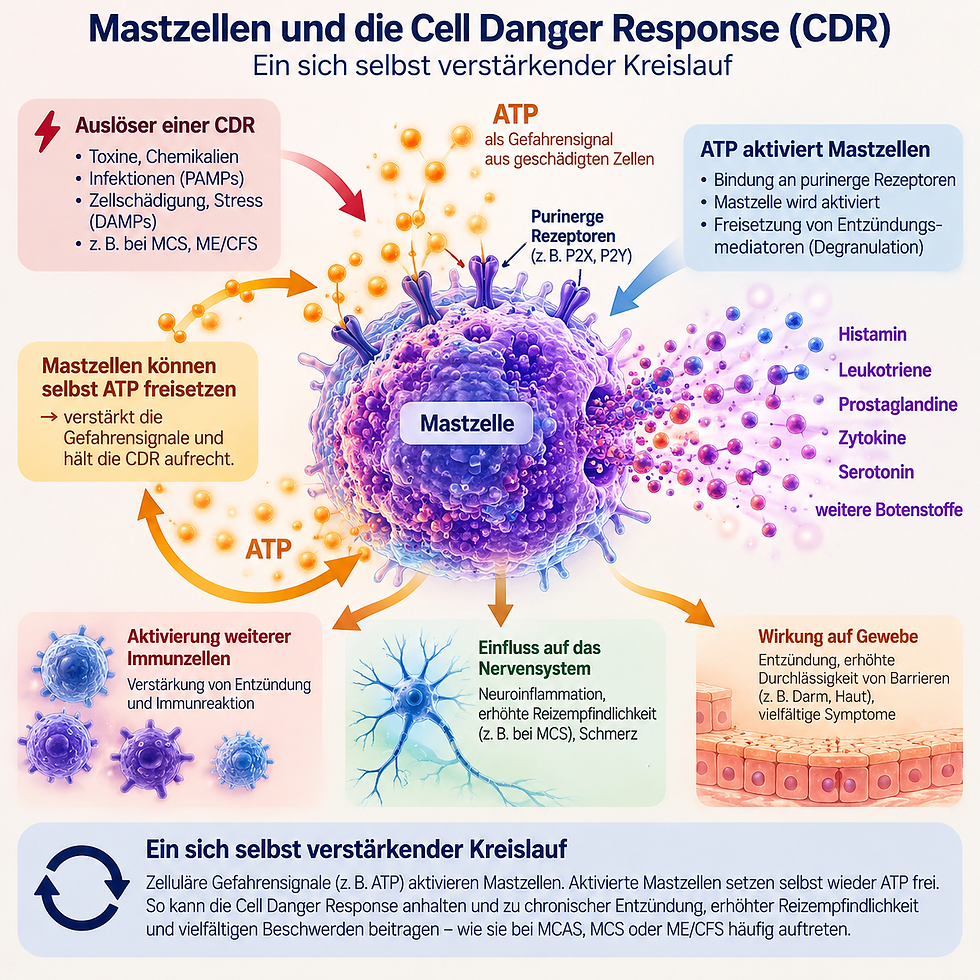
This is where our work at the Safety Retreat comes in: We combine Naviaux's Cell Danger Response model with neuroplastic approaches. The CDR model provides a framework for understanding cellular protective and adaptive responses. Neuroplasticity describes the nervous system's ability to modify its processing and reactions through learning and experience.
We combine this understanding with practical ways to exert influence oneself.
This includes new experiences of safety, a changed approach to symptoms and automatic alarm reactions, and space for feelings.
According to Naviaux, we describe the underlying idea as the “metabolism of trust” : making safety tangible in everyday life and developing new ways of reacting.
Your body is on your side.
Sources: Eguchi et al., 2026, Journal of Translational Medicine ; Naviaux et al., 2016, PNAS .